
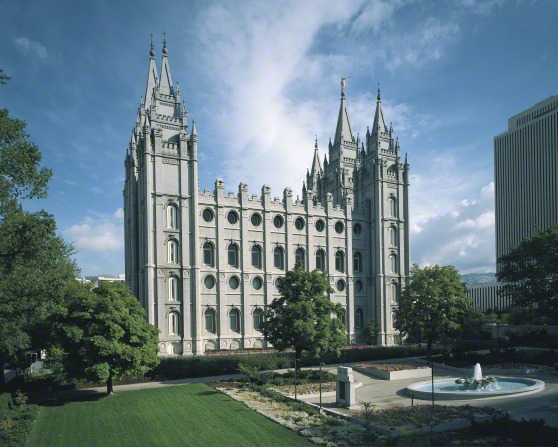
Temples are the most sacred places on earth for members of The Church of Jesus Christ of Latter-day Saints. They are, literally, houses of the Lord where the crowning blessings of the gospel of Jesus Christ are available. President Gordon B. Hinckley said:
These unique and wonderful buildings, and the ordinances administered therein, represent the ultimate in our worship. These ordinances become the most profound expressions of our theology.
Mormon temples are different from meetinghouses. In local meetinghouses, Sunday worship services are conducted, and the gospel of Jesus Christ is taught to people of all ages. Elder L. Tom Perry taught:
… The Lord … has commanded us to build houses of worship for the purpose of having a place where the gospel can be taught. After understanding is achieved, we can enter into covenants with Him to be obedient to His will and, in turn, receive His promised blessings as a result of our faithfulness. We have temples—they now dot the maps of nations—here the worthy can enter, worship, be taught, and make covenants to serve God and abide by His law.
The ordinances and work of the temple are at the heart of what Latter-day Saints do. President Russell M. Nelson taught:
Every activity, every lesson, all we do in the Church, point to the Lord and His holy house. Our efforts to proclaim the gospel, perfect the Saints, and redeem the dead all lead to the temple. Each holy temple stands as a symbol of our membership in the Church, as a sign of our faith in life after death, and as a sacred step toward eternal glory for us and our families.
Mormon Temples Provide Ordinances for the Living
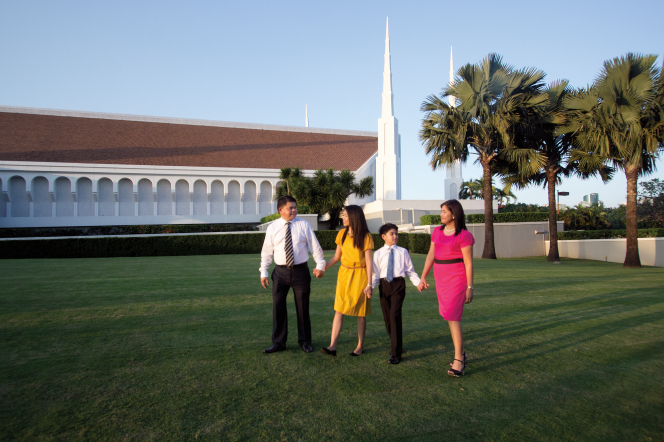
Much of the instruction and teaching in the temple is done in sacred rituals, called ordinances, where individuals make covenants with God. Elder Robert D. Hales said:
The primary purpose of the temple is to provide the ordinances necessary for our exaltation in the celestial kingdom.
In other words, to obtain the highest degree of glory in the afterlife, we must first partake of the saving ordinances of the gospel of Jesus Christ. Of the holy temple, President Boyd K. Packer said:
There members of the Church who make themselves eligible can participate in the most exalted and sacred of the redeeming ordinances that have been revealed to mankind. There we may be washed and anointed and instructed and endowed and sealed. And when we have received these blessings for ourselves, we may officiate for those who have died without having had the same opportunity.
These ordinances are most sacred to Latter-day Saints, and are spoken of outside the temple in general, not specific, terms. President Packer taught:
The ordinances of washing and anointing are referred to often in the temple as initiatory ordinances. It will be sufficient for our purposes to say only the following: Associated with the endowment are washings and anointings—mostly symbolic in nature, but promising definite, immediate blessings as well as future blessings.
The next ordinance is called an endowment. Elder Hales explained:
Temples are the greatest university of learning known to man, giving us knowledge and wisdom about the Creation of the world. Endowment instructions give guidance as to how we should conduct our lives here in mortality. The meaning of the word endowment is “gift.” The ordinance consists of a series of instructions on how we should live and covenants we make to live righteously by following our Savior.
And, finally, is the sealing ordinance. When a husband and wife are married in the temple, they are sealed together with this ordinance, and their marriage, if both continue in worthiness, lasts beyond the grave. President Packer said:
The sealing ordinance is that ordinance which binds families eternally. Temple marriage is a sealing ordinance. Children born to couples sealed in the temple are born in the covenant. When a couple has been married in a civil ceremony and then sealed in the temple a year or more later, children not born in the covenant are sealed to the couple in a brief and sacred ordinance.
These ordinances are available only with the proper authority, or priesthood keys. President Packer explained:
I have always been impressed that the ordinances of the temple are reverently and carefully administered. They are not complicated or extravagant but are typical of the simplicity of the principles of the gospel.
In the Church we hold sufficient authority to perform all of the ordinances necessary to redeem and to exalt the whole human family. And because we have the keys to the sealing power, what we bind in proper order here will be bound in heaven. Those keys—the keys to seal and bind on earth and have it bound in heaven—represent the consummate gift from our God. With that authority we can baptize and bless, we can endow and seal, and the Lord will honor our commitments.
Mormon Temples Provide Ordinances for the Dead

Baptismal font in the Quetzaltenango Guatemala Temple.
Latter-day Saints believe that only those who have received the saving ordinances— which include baptism, receiving the gift of the Holy Ghost and the ordinances received in the temple— can receive the highest blessings in the kingdom of God. President Packer said:
… Life is a homeward journey for all of us, back to the presence of God in his celestial kingdom. Ordinances and covenants become our credentials for admission into His presence. To worthily receive them is the quest of a lifetime; to keep them thereafter is the challenge of mortality.
The question then becomes, what happens to those who die without the opportunity to partake of these ordinances and make these covenants with God? President Packer said:
One of the characteristics that sets us apart from the rest of the world and identifies us as the Lord’s Church is that we provide baptism and other ordinances for our deceased ancestors. …
With proper authority a mortal person could be baptized for and in behalf of someone who had not had that opportunity before passing on. That individual would then accept or reject the baptism in the spirit world, according to his own desire. …
We have been authorized to perform baptisms and other temple ordinances vicariously for the dead so that when they hear the gospel preached and desire to accept it, those essential ordinances will have been performed.
Latter-day Saints believe that they are presenting opportunities for those who are deceased to accept or reject the ordinances performed by proxy in their behalf. As President Packer taught:
Those who have been to the temple have been taught an ideal: Someday every living soul and every soul who has ever lived shall have the opportunity to hear the gospel and to accept or reject what the temple offers. If this opportunity is rejected, the rejection must be on the part of the individual himself.
Sacred House of Learning
The temple is a sacred house of learning for Latter-day Saints. President Boyd K. Packer said:
The temple is a great school. It is a house of learning. In the temples the atmosphere is maintained so that it is ideal for instruction on matters that are deeply spiritual.
The teachings of the temple help to answer the fundamental questions of our mortal existence. President James E. Faust said:
A unique feature of The Church of Jesus Christ of Latter-day Saints is its teaching concerning temples and the eternal significance of all that occurs within them. … President Gordon B. Hinckley has stated of these temples, “There are only a few places on earth where man’s questions about life receive the answers of eternity.” The solemn mysteries of where we came from, why we are here, and where we are going are answered more fully in the temples. We came from God’s presence and are here on earth to prepare to return to His presence.
Much of the instruction in the Mormon temple is symbolic. Sister Silvia H. Allred said:
The temple is a house of learning. Much of the instruction imparted in the temple is symbolic and learned by the Spirit. This means we are taught from on high. Temple covenants and ordinances are a powerful symbol of Christ and His Atonement. We all receive the same instruction, but our understanding of the meaning of the ordinances and covenants will increase as we return to the temple often with the attitude of learning and contemplating the eternal truths taught.
Through the ordinances and covenants we make in the temple, we also learn how to conduct our lives to as to qualify ourselves to return to the presence of God. Elder Hales said:
The opportunity to enter the temple and to take upon ourselves the sacred covenants therein is one of the greatest blessings available to us in mortality. Then, after we take upon us those covenants, our obedience in living them daily stands as a demonstration of our faith, love, devotion, and spiritual commitment to honor our Heavenly Father and His Son, Jesus Christ. Our obedience also prepares us to live with Them in the eternities. The temple’s saving ordinances are essential to—and even the central focus of—the eternal plan of happiness.
This is the reason that temple blessings are so important to Latter-day Saints—and why they seek to provide the same opportunities for their deceased ancestors.
The House of God is Sacred, not Secret
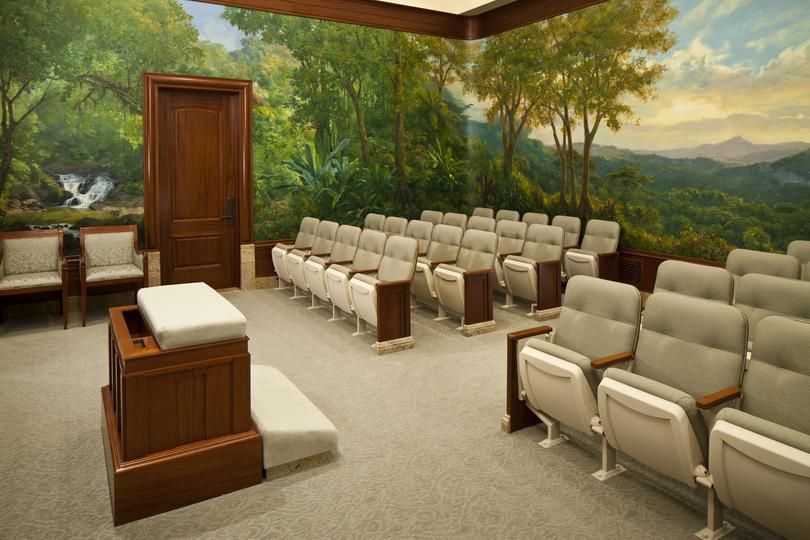
Ordinance room in San Salvador, El Salvador, Temple.
The blessings and ordinances of the temple have had a certain aura of mystique for many years, in large part because Latter-day Saints do not discuss them openly. But rather than being secret, they are sacred. President Boyd K. Packer explained:
A careful reading of the scriptures reveals that the Lord did not tell all things to all people. There were some qualifications set that were prerequisite to receiving sacred information. Temple ceremonies fall within this category.
We do not discuss the temple ordinances outside the temples. … The ordinances and ceremonies of the temple are simple. They are beautiful. They are sacred. They are kept confidential lest they be given to those who are unprepared.
Preparation requires effort on the part of the individual. President Packer said:
Curiosity is not a preparation. Deep interest itself is not a preparation. Preparation for the ordinances includes preliminary steps: faith, repentance, baptism, confirmation, worthiness, a maturity and dignity worthy of one who comes invited as a guest into the house of the Lord.
But sacred does not mean secret, nor does it mean that the blessings of the temple are only intended for a chosen few. President Packer said:
It was never intended that knowledge of these temple ceremonies would be limited to a select few who would be obliged to ensure that others never learn of them. It is quite the opposite, in fact. With great effort we urge every soul to qualify and prepare for the temple experience.
Full preparation for the temple is important. President Nelson explained:
To enter the temple is a tremendous blessing. But first we must be worthy. We should not be rushed. We cannot cut corners of preparation and risk the breaking of covenants we were not prepared to make. That would be worse than not making them at all. …
Because the ordinances and covenants of the temple are sacred, we are under solemn obligation not to speak outside the temple of that which occurs in the temple.
In the temples, Latter-day Saints make sacred covenants with God. These covenants are two-way promises between a person (or persons) and God, and God sets the terms. The violation of these covenants brings serious consequences. Those who are not fully prepared to abide by their covenants should not make them. Thus, full preparation is essential.
Preparing to Enter the Temple
The ordinances of the temple are available to all baptized, worthy members of The Church of Jesus Christ who are sufficiently prepared. Youth ages 12 and older are eligible to participate in the ordinances of proxy baptisms for the dead. There is no specific age limit for the other temple ordinances, but a person must have been a baptized member of The Church of Jesus Christ for at least a year. Often, young adults receive their temple endowments in preparation for serving a proselytizing mission for The Church of Jesus Christ or just before a temple marriage. If single, adults receive their endowments at a mature time in life.
The true measure is spiritual maturity, and that is a decision made between the person and his or her ecclesiastical leader in a temple recommend interview. President Packer explained:
The interview for a temple recommend is conducted privately between the bishop and the Church member concerned. Here the member is asked searching questions about his personal conduct and worthiness and about his loyalty to the Church and its officers. The person must certify that he is morally clean and is keeping the Word of Wisdom, paying a full tithe, living in harmony with the teachings of the Church, and not maintaining any affiliation or sympathy with apostate groups. The bishop is instructed that confidentiality in handling these matters with each interviewee is of the utmost importance.
Acceptable answers to the bishop’s questions will ordinarily establish the worthiness of an individual to receive a temple recommend. If an applicant is not keeping the commandments or there is something unsettled about his life that needs putting in order, it will be necessary for him to demonstrate true repentance before a temple recommend is issued.
After the bishop has conducted such an interview, a member of the stake presidency likewise interviews each of us before we go to the temple.
The most important signature on the temple recommend, however, is that of the one seeking to attend the temple. When a person signs his or her recommend, he or she is certifying before the Lord of his or her own worthiness to enter the temple. Sister Allred said:
The temple is the house of the Lord. He directs the conditions under which it may be used, the ordinances that should be administered, and the standards that qualify us to enter and participate in temple worship. … Personal worthiness is an essential requirement to enjoy the blessings of the temple.
President Nelson added:
Such requirements are not difficult to understand. Because the temple is the house of the Lord, standards for admission are set by Him. One enters as His guest. To hold a temple recommend is a priceless privilege and a tangible sign of obedience to God and His prophets.
The sacred covenants and ordinances available only in the holy temples point us toward God and His divine plan for us. President Thomas S. Monson said:
Until you have entered the house of the Lord and have received all the blessings which await you there, you have not obtained everything the Church has to offer. The all-important and crowning blessings of membership in the Church are those blessings which we receive in the temples of God.
More on Mormon Temples:
What do Mormons do in the temple?
Who can attend the temple? Why is there so much secrecy concerning Mormon temples?
Mocking the Mormon Temple?
Unlike a Catholic priest or a Buddhist monk, a Mormon couple leaves the sacred temple to live in the world, to be “in the world, but not of the world.”
Mormon Baptism for the Dead
Keith L. Brown is a convert to The Church of Jesus Christ of Latter-day Saints and serves as the Ward Mission Leader in the Annapolis, Maryland Ward. Why are Mormons Baptized for the Dead? The dictionary defines the word “proxy” as “a person who is authorized to act on behalf of another.” A “proxy […]
Mormon Temple Ritual
The word ritual is defined as follows: : Of or relating to rites or a ritual: ceremonial, such as a ritual dance. According to religious law, as in ritual purity. done in accordance with social custom or normal protocol, as in ritual patterns of movement. The word ritual derives from the word rite. A rite […]
Mormon Underwear
Mormon Underwear: the Mormon Temple Garment Mormons wear white in the temple, changing out of their street clothes in dressing rooms in the temple. Street clothes are worn in the temple by people attending weddings, called “sealings,” performed in the “sealing rooms” of the temples. (See Inside Mormon Temples.) Mormon garments, also referred to as […]
Temples Secrecy
Mormons consider the temple experience to be sacred, not secret. In 1 Corinthians 3:2 it says, “I have fed you with milk, and not with meat: for hitherto ye were not able to bear it, neither yet now are ye able.” Christ was always careful towards the people He taught, giving them only as much information […]
What do Mormons do in the Temple?
Temple Marriages and Family Sealings The temple is the House of the Lord, and therefore is employed for the most exalted of ordinances. “Sealings” may be performed in the temple to unite husband and wife for “time and all eternity,” as well as to seal children to their parents. Sealings are performed in “sealing rooms” in the temples. Sealing rooms […]
Who can Attend the Temple?
Mormon meetinghouses, where Sunday meetings and weekly activities are held, are open to anyone who desires to visit. All are welcome. Temples, however, are different than meetinghouses (also called chapels). Where meetinghouses are spare in their decor, temples are ornate, and made of the finest materials. Temples are normally closed on Sundays and sometimes Mondays, […]